Hanger 13 - A Lethal High

Hanger 13 was a hard core rave venue, situated in Ayr, near Glasgow in Scotland. The author of these words admits to frequenting this establishment on numerous occasions, whilst studying at a nearby university.

Iit was closed down some time ago, after adverse publicity following several drug deaths. Your scribe has predominately fond memories of the place, but was present the night someone died on the dance floor after consuming a cocktail of drugs.

He was also present at another rave, outdoors in another part of the country, only a few weeks later, when he witnessed another fatality. The circumstances are hard to relate, the author is minded of some lyrics by the Alabama 3, which almost perfectly describe the circumstances.

"There was this one particular girl, though, she was so beautiful, she used to knock my eyes out every damn time. One night she flipped this funny little heart-shaped pill and just died there right in front of me. Now she don’t dance to techno anymore."

Béziers - Where Everybody Was Murdered

Béziers is a peaceful town in southwest France, but it hides a frightening history.

On July 22nd, 1209 AD, the town was at the centre of one of the bloodiest battles of The Crusades . The town was put to the sack by the Christian French army,but the question arose as to how to tell which of the towns inhabitants were damned hereticss and which were good Christians. Simon V Du Montfort (or perhaps a legate of Pope Innocent III) said he had an easy solution. "Kill them all," he said "For the Lord will know his own". And so tens of thousands of men women and children were put to death.

Arnold, abbot of Citeaux describes the carnage, using words that do not befit a monk:

"Our forces spared neither rank nor sex nor age. About twenty thousand people lost their lives at the point of the sword. The destruction of the enemy was on an enormous scale. The entire city was plundered and put to the torch. Thus did divine vengeance vent its wondrous rage."

The author of these words signs off for the evening. The moon has just gone behind a cloud and a dog howls, somewhere in the distance.

Hardly Getting Over It

Hüsker Dü, were a little known, but influential, American alternative rock band who split up in 1988.

Most of their seven albums were packed full of very high speed, abrasive punk tunes. However they will forever by remembered by the author of these words for one song - Hardly Getting Over It. This is an acoustic effort, their only one, and lasts for over six minutes.
Written and sung by guitarist Bob Mould, the lyrics speak of death and despair. There is a sound like a tolling of a bell in the music. It's hard to envisage what went through the great man's mind when he wrote it:

Hardly Getting Over It

Twenty years ago, saw a friend was walking by
And I stopped him on the street to ask him
How it went, and all he did was cry
I looked him in the face, but I couldn't see past his eyes
Asked him what the problem was, he says
"Here is your disguise"

Now he's hardly getting over it
Hardly getting used to getting by
Old man lays down by the railroad tracks
Got no paper in his pocket, got no paper on his back
I asked him what the time was, he says "Hit the road now, Jack"

Went back to see him next week
He died of a heart attack and died away
Now he's hardly getting over it
Hardly getting used to getting by

Grandma, she got sick, she is going to die
And grandpa had a seizure, moved into a hotel cell and died away
My parents, they just wonder when they both are going to die
And what do I do when they die?

Now I'm hardly getting over it
Hardly getting used to getting by

Naples - Horrors Of The Past and Future

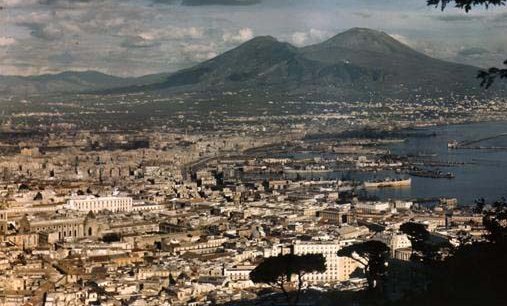
In his book, Naples '44, Norman Lewis described a city ravaged by war and suffering terrible poverty.

By 1944 the inhabitants of Naples were so destitute that all of the tropical fish in the city's aquarium had been devoured. Olive oil was sold for a price similar to that of gold, there were no farm animals left alive within 30 miles of the city. The Mafia thrived.

Lewis, who was in Naples as an Intelligence Officer attached to the American Army, observed that even respectable women in the city had been driven to prostitution to make ends meet. He saw a young Italian boy who had lost three fingers - they had been chopped of by a bayonet when he tried to pilfer some food from the back of an army lorry.

Bandits ran wild, Italian, German and American army deserters hid in the surrounding hills. During the first half of 1944, half of all food convoys entering the city were ambushed.

In 2006, Naples is a city unrecognizable from the horrors of 60 years ago, but which still seems very much poorer than the thriving cities in the north of Italy. Naples is also well known for having the worst standard of driving in the western world. It has, perhaps unkindly, been described as "dangerous, filthy, the armpit of Italy"

The author of these words, a fan of quirky, out of the way places, contemplates a visit to Naples. He reconsiders when he remembers that the scene which will one day face the city will make the events of 1944 pale in to insignificance. Naples is sitting on a 400-square-kilometre reservoir of magma, just waiting to explode. One day, no one knows when but it will happen, Naples will be buried underneath the ash, just like Pompeii. The author, apprehensive of been in the wrong place at the wrong time, opts to stay away.

Wholesale Slaughter At The Colosseum

During the hundred days of the opening games at The Colosseum in Rome in 80 AD, more than 5000 animals were killed. These included elephants, tigers, lions, elks, hyenas, hippopotamuses, and giraffes

The Cruel Shores Of The Scilly Isles

Admiral Sir Cloudesley Shovel (1650-1707), Commander In Chief of The British Fleet, was a popular British hero, who celebrated a long and distinguished naval career .

He was killed, along with 1400 of his men, off The Scilly Isles, when their ships ran in to jagged rocks just offshore. It was believed that he drowned with the others.

Many years later another, more sinister, story came to light. An old lady on the Scillys, when on her deathbed confessed that she had murdered Admiral Shovel, who had managed to swim from his stricken ship and stagger ashore. She said that she had strangled him in the belief, current at the time among coastal inhabitants, that a body, alive or dead, washed up was a derelict, thus giving her legal possession of the emerald ring on the Admiral's finger. She produced the stolen ring as evidence.

The Last Of The Yahi Tribe

Ishi (1860-1916) was the name given to the last member of the Yahi tribe of California. Ishi is believed to be the last Native American to have lived the bulk of his life outside the influence of European American culture. He emerged from the wild in 1911 near Oroville, California after leaving behind his ancestral homeland, the hills and mountains above. His real name was never known, because in his society it was taboo to say one's own name. Since he was the last member of his tribe, his real name died with him. The photo to the left was taken shortly after he was found.

Prior to European contact, the Yana population numbered approximately 3,000. Ishi and his family were victims of the Three Knolls Massacre, from which approximately 30 Yahi survived. The remaining Yahi escaped but went into hiding for the next forty years after cattlemen killed about half of the survivors. Eventually Ishi's mother and other companions died, and he was discovered by a group of butchers in their corral in Oroville. August 29, 1911.

He only lived another five years, before succumbing in 1916 to tuberculosis in the alien surroundings of the University Of California Hospital. Eighty-four years after his death, Ishi was finally buried in his proper resting place.

Your humble scribe signs off for the evening. He wonders at what went through Ishi's mind the day his last kinsman died and he sighs, knowingly, at how desolation can drive a man out of the hills and forests he knows, in to the strange and unforgiving beyond

Godfrey's Cordial

In nineteenth century Britain, use of opium was widespread and unregulated. Medical officers were convinced that one of the major causes of infant mortality was the widespread practice of giving children narcotics, especially opium, to quieten them.

A substance known as Godfrey's Cordial , a mixture of molasses and opium was especially popular. Supposed to ease the irritation of colic in children , it also had the effect of knocking them out cold for several hours afterwards. It's use was said to be endemic in parts of Manchester. East Anglia was also a stronghold of opium abuse, opium in pills and penny sticks was widely sold. In Nottingham, one chemist sold 400 gallons of laudanum in a year.

It is thought that Godfrey's Cordial was also used for a darker purpose. An overdose could be fatal and countless parents found that it brought a quick, painless death to unwanted children for whom there was neither space nor food.

Horses Of The Great War

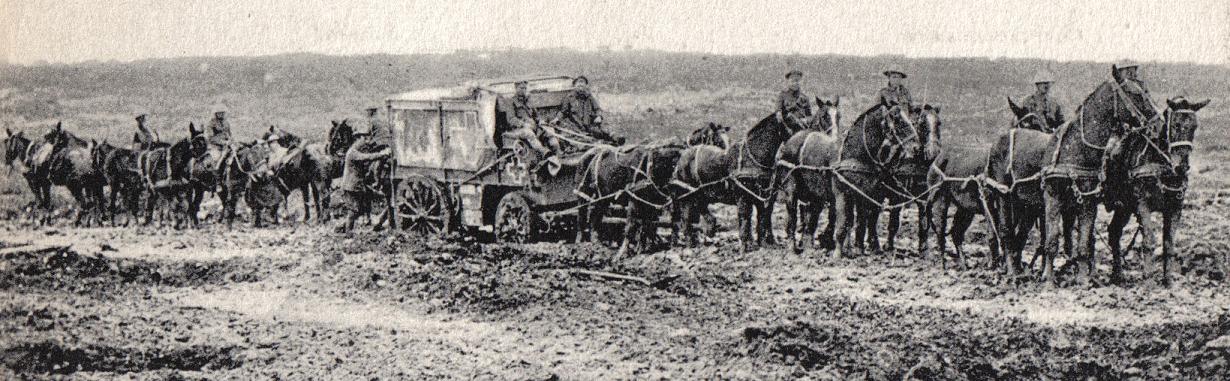
During the Great War, 256 000 horses, mules and donkeys were killed, or died of disease, whilst serving their country. The animals were used for for transporting food, water and ammunition to the front line and for carrying artillery beyond the line, in to the face of heavy fire.

The loss of life was so heavy that in 1916, the British Government introduced compulsury purchase orders for horses , many thousands of pet and farm horses were seized and taken to the foreign battlefields. Horses continued to die in huge numbers. Many drowned in the mud, were shot or hit by shells (they were bigger targets), others died of sheer fatigue.

A most heart-wrenching account of a draught animal's plight was recorded by Lieutenant R G Dixon, 14th Battery, Royal Garrison Artillery:

"Heaving about in the filthy mud of the road was an unfortunate mule with both of his forelegs shot away. The poor brute, suffering God knows what untold agonies and terrors, was trying desperately to get to its feet which weren't there. Writhing and heaving, tossing its head about in its wild attempts, not knowing that it no longer had any front legs.

I had my revolver with me, but couldn't get near the animal, which lashed out at us with its hind legs and tossed its head unceasingly. Jerry's shells were arriving pretty fast – we made some desperate attempts to get the mule so that I could put a bullet behind its ear into the brain, but to no avail...The shelling got more intense – perhaps one would hit the poor thing and put it out of its misery." (Source)

In March 1918, the British launched a cavalry charge at the Germans. Out of 150 horses used in the charge only 4 survived. The rest were cut down by German machine gun fire.

At the end of the war, the animals who remained were not treated with the dignity and gratitude they deserved. Many good qualiy horses remained with the army, the 'standard' and 'poor quality' animals were either auctioned off at rock-bottom prices or sold to French butchers, a terrible fate given the services these brave beasts had performed. Instead of an honourable retirement they were slaughtered for their meat or worked to death in farms, mills and factorys.

In 1934, 16 years after the war had ended Mrs Brooke - based in Cairo, Egypt, with her husband Brigadier Geoffrey Brooke - was horrified to discover that, at the end of the war, the once proud cavalry stock were abandoned. Old, decrepit and wounded from the battlefield they were handed over to gharry drivers into a daily grind of poverty and suffering. She founded the Hospital for Old War Horses, now known as the Brooke Foundation 60 years later, the London-based charity operates hospitals in Egypt, Pakistan, India and Jordan.

The author signs of for now, saddened at the scant regard humankind gave to the animals who served them so well.

Sacrifice

Sinead O'Connor has one of the most beautiful and haunting singing voices of our era.

This song entranced the author of these words.

Death Of The Cornish Language

Dolly Pentreath was a resident of Mousehole who became famous as the person who spoke Cornish as her main language. She was brought up as a Cornish speaker and learnt only to speak English as an adult. Her famed was secured by a visitor to Cornwall called Daines Barrington who discovered Dolly and some other Cornish speakers in Mousehole at a time when it was believed the language had died. Her name now lives on in popular history as the last native Cornish speaker. To all speakers after her the language was learnt after English as a second language.

The last person to die who spoke ONLY Cornish was Chesten Marchant, who died in in 1676 in Gwithian, Cornwall.

The last person to die who had an inherited knowledge of the Cornish language was John Davey from Zennor who died in 1890 , he kept the language alive by speaking Cornish to his cat.

There has been a recent revival of the Cornish language, there are now about 300 speakers in Cornwall and 50 in London, but none of these speakers were taught the language by their parents, it was all picked up from reference books.

Pedro de Serrano -The Ultimate Castaway

Pedro de Serrano was a Spanish sailor who was marooned on a small Caribbean Island in the early part of the sixteenth century.

The recorded circumstances of his experience are rather vague and most certainly open to dispute. The basic details are that he was the only survivor of a ship wreck and was washed up on a deserted, barren strip of sand. He had only the clothes he stood up in. For years he endured the most primitive of living conditions. As there was no fresh water supply on the island, he survived the first days be drinking turtle blood. Soon he was able to use upturned turtle shells as rain water receptacles. The only other food he was able to find was sea weed and the occasional shell fish. He had no shelter from the sun and, during the hottest hours of the day, he buried himself in wet sand to keep cool. Soon his clothes had rotted and Serrano wandered his domain naked, but for a thick down of body hair. A flint, washed up from the ship wreck was his salvation, he was able to make fire and therefore retained the faint hope that a passing vessel might see his distress signal.

After some years, two other sailors were washed up on the beach. When they saw the furry image of Serrano, who also boasted a waist length beard by now, they were terrified and, at first, did not believe him to be human. Although there was still no imminent hope of rescue, Serrano was overjoyed to have the company of other humans again, his joy was short lived - Within a few days, one of the men began raving. Soon he began eating his own arms, and then he quickly died. A short time later the intense heat from the sun and the harsh living conditions on the island took the life of the other man. Serrano was alone again.

After seven or eight years marooned, Serrano was eventually rescued by a passing ship, many other vessels has passed, but none were able, or willing, to risk the dangerous coral that barricaded the island.

Understandably, Serrano never fully recovered from his years of isolation, he died a mad man in his native Spain.

Your humble scribe signs off for the evening, he wonders how he would have survived seven years of wild isolation and concludes his own mental health would have also been irreversibly altered.

Moho Tani - The Ghost Island

Moho Tani is a small, remote isle which forms part of the Marquesas Island group in Polynesia. Years ago, before the white man came, it was heavily forested and populated by natives who had lived there, co-existing with the fragile eco system, for many hundreds of years.

The tranquility of everyday life was shattered when, over 200 years ago, a European ship anchored down in the blue water surrounding the island. Men came ashore with their firearms blazing, they sought water, women and pigs. They didn't stay long, but left behind disease. The islanders, with zero immunity to the introduced viruses, succumbed in their droves. This is a common story of small isolated islands all over the world when they are 'discovered', but on Moho Tani the devastation was total. Not a single native survived. No history of their people is known, because there was no one left to tell it.

When the people were no more, their sheep ran wild. They bred out of control, with the extinction of man, they had no predators. In time, hordes of sheep had eaten all of the grass and shrubs on the island and then, when famine set in, they ate the leaves of the trees and then stripped the trees of bark, soon all the trees in the forests had had died as well.

Without trees to shelter the soil from the scorching rays of the sun and without roots to hold humidity near the surface, every drop of rain sank deep in to the arid ground and was lost long before it reached any watercourse. The gushing streams lost all their supplies and the last rivulets dissapeared from the surface of the land. Moho Tani now resembles a desert.

Thor Heyerdahl in his book Fatu Hiva - Back To Nature, wrote of a two hour visit to Moho Tani in 1938, by then the island was already depopulated. He wrote:

"...Never before had the sun, the very intensity of the sunlight, given me the same feeling as when a full moon shines on a cemetery. The ghostly white dead trees stood like tombstones over a pillaged graveyard. There were skulls and bones everywhere. It was like midnight at noon"

The author of these words signs off for now. He wonders what the Moho Tani islanders might have taught us, if they had only lived to tell the tale. He wonders how the human era finally ended. Perhaps the last surviving Polynesian died quietly in his or her hut, maybe a last desperate family took to their canoe looking for better prospects on another island, although no other lands are visible from Moho Tani. Or perhaps the last survivor was a child, left alone between the trees and the animals. We shall never know.

The Iolaire Disaster


During the dark small hours of New Year’s morning, 1919, the Admiralty yacht, HMY Iolaire, with nearly 300 men aboard, foundered on the ominously named rocks, The Beasts of Holm, just yards from shore and within a mile of the safety of Stornoway Harbour on Lewis in the Western Isles.

The men aboard were returning from the horrors of the Western Front at the conclusion of the Great War. Although within site of their homeland, almost within touching distance, rough seas prevented them from swimming ashore. Many who attempted were drowned, one man, John MacLeod bravely succeeded in getting ashore with a line, from which a further 30-40 men were able to drag themselves to safety. The last survivor was not found until daylight - one man, Donald Morrison, was found still hanging on to the rigging for dear life. Seven others had been with him, but had not been able to hang on throughout the night.

205 men were drowned that day. For such a close knit and remote island community, the tragedy must have come as unbearable blow. The loss cannot be imagined, not a family was unaffected.


(Iolaire survivors Donald Morrison and John Macleod)


The loss of over 200 men, together with the 1000 who had died in the trenches, effectively deprived Lewis of a generation of men. Emigration to America and the mainland UK escalated. Today the population of Lewis is half of what it was the night the Iolaire went down.

Your scribe signs of for the evening, disturbed at this savage twist of fate - To get so close to home, after been so far away for so long, only to drown within site of land. If there is a God, he works in cruel and mysterious ways.

The Blind Army

Between the years of 976 and 1018 AD, a state of war existed between Bulgaria and the Byzantine Empire, led by Basil II and nicknamed the "Bulgar-Slayer".

The culmination of one particular episode of the carnage, at the Battle of Kleidion in 1014, was especially grim. 14000 Bulgarian soldiers were ambushed in a valley and trapped, they had little choice but to surrender and were swiftly taken prisoner. King Basil divided the soldiers in to groups of 100, blinded 99 men in each group, and left one man in each with one eye so that he could lead the others home.

It is said that the King of Bulgaria, Samuil, died of a heart attack when he saw his newly blinded army march past him, other reports say he died three months later, either way the effect must have been devastating.

The author of these words shudders at the thought of those thousands of blind men struggling to find their way home, groping in to the darkness and pinning their hopes on just one man, somewhere in the group, with only one eye. He also wonders at he eventual fate of the blinded soldiers, what use did eleventh century Bulgaria have for 14000 blind men? One suspects their subsequent years were spent in poverty and misery.

The Last Of The Shakers

The Shakers were a religious sect, an offshoot of the Society Of Friends (Quakers), who originated from the UK in the late eighteenth century.

They followed the teachings of Mother Anne Lee and the name "Shaker" derives from their habit of trembling, shouting, dancing, shaking and singing during religious worship. Anne Lee was frequently harassed by the authorities in the UK and imprisoned on several occasions for blasphemy. During one stay in Manchester Prison, Anne Lee stated she had "directions from God" to take her band of followers to America. They founded a community in Watervliet, New York State in 1776.

Over the following decades their numbers swelled to a peak of perhaps 6000 members in the 1840s. As they practised celibacy, they were unable to 'breed' new members of the sect, they overcame this by adopting the children of local "fallen women". Many other Shaker communites were founded throughout America, the town of Shaker Heights in Ohio was originally one of these settlements.

As with many sects, the appeal of the religion eventually began to wane and by 1908 there were only around 1000 remaining Shakers. Their numbers have continued to decline since then.
In 1992 Ethel Hudson , the last surving member of the community at Canterbury, New Hampshire, died at the age of 96. This left just one remaining Shaker community, at Sabbathday in Maine.

It is unclear how many Shakers remain alive, certainly less than ten, possibly as few four. It is evident that there days are now seriously numbered and in a matter of years they will be gone forever. They will leave an impressive legacy, not only did they practise a unique religion, but they left their mark on subjects as diverse as furniture design and hymn writing.

The author of these words, an agnostic, will mourn the passing of the last Shaker. If anyone reading this knows the exact number of those who remain, he would be very interested to know the answer.

Ohio - The Great Slaughter Of 1822

Your humble scribe offers the following tale as todays melancholy fare...In an unnamed pioneer township in Ohio, wild animals, ravenous beasts of the night, were devouring the populations chickens, hogs and cows. So great were the losses that one of the bloodiest big game hunts in history was instigated.

The town's men armed themselves and posted themselves around the borders of their colony. At the cry of a horn, echoed from bugler to bugler, the men waded forward, driving game before them towards the centre of the township. When the ring had been tightened to some half mile in diameter, an order was given to fire and the men fired at will.

They shot everything that moved. After the thrashing had stopped they waded forward once again, shooting every beast they flushed from the thickets and swamps. At last the circle closed and the men faced each other over the carcasses of twenty two bears, seven wolves, one hundred and three deer, two mountain lions, one wildcat, plus turkeys and countless smaller game.

*
Within five decades of the first settlers arriving in the area the following animals were extinct: elk, panther, wolf, bear, wild cat, beaver, black and yellow rattlesnakes, bald eagle.

Turning Her Grief In To Glory

One of the competitors of the 2006 Melbourne Commonwealth Games Women's Triathlon, was the Australian, Emma Snowsill.

Four years ago, her boyfriend and training partner Luke Harrop was killed when he was hit by a car on a training ride. Devastated, she stopped training and in the months that followed his death she seemed to withdraw from the triathlon world, for very understandable reasons.

Months later Luke's sister, Loretta Harrup, another triathlete visited Emma. After Loretta offered to be her practice partner, Emma was persuaded to start training again.

Another two years passed during which Emma swam, cycled and ran with renewed vigor and determination, no doubt inspired to train in memory of Luke. This, combined with the training and guidance of Loretta, herself an Olympic medalist, obviously worked wonders. At the Melbourne Games, Emma Snowsill won a magnificent gold medal, the winning margin was over 30 seconds, this despite her stopping before the finish-line to exchange long hugs and congratulations with friends and family.

Your humble scribe salutes the courage of Emma Snowsill and wishes her every success at the 2008 Olympics. He signs off for now, comforted by the thought of the happiness and hope that can sometimes spring from desolation.

The Plight Of The Albatross


Gough Island, lies far out in the Atlantic Ocean, it's nearest neighbor is Tristan da Cunha - itself the world's remotest inhabited island.

Gough is an important sea bird colony and hosts one of the world's largest albatross breeding grounds.

Conservationists have recently reported aggressive groups of unusually large and violent human-introduced house mice which have been posing a problem for the breeding grounds: The mice are eating alive defenseless albatross chicks sitting on their nests.

The chicks, described as "big spherical balls of fat covered in down", have no defense mechanism against the mice. The attacker weighs about 50 grams, the victim can weigh 10-12 kilos.

The albatross faces a perilous future. Not only are the chicks been devoured alive, but other factors such as line fishing and ingestion of plastic floatsam are also causing their wholesale destruction. Of the 21 species of albatross, 19 are threatened with extinction.

Many have admired these majestic birds. They can soar for miles, for days without flapping their wings, the wingspan of a wandering albatross can reach 11 feet, all species of albatross mate for life - and an albatross can live for 60 years. The author of these words grieves at their bloody slaughter and curses his fellow man for the terrible harm wrought upon a species that has never caused humans even the slightest danger.

The Catastrophe Of Los Alfaques

For years, locals who lived near the campsite at Los Alfaques, close to the to the town of Tortosa in southern Spain had been complaining to the authorities that tanker drivers were using the dangerous, twisting coast road rather than pay the toll on the nearby expressway. Residents were alarmed, for they new the tankers were full of pressurized liquid gas from the nearby refinery of Tarragona.

The authorities made a fatal mistake when they refused to listen. In July 1978 a tanker crashed in to the campsite and burst in to flames. Blazing gas spewed over a radius of 400 meters and a 60 meter ball of fire swept through the site setting caravans and tents ablaze. The force of the explosion was so strong that some tourists on the adjacent beach were blown in to the sea.

More than 170 people died , many bodies charred beyond recognition, all because a driver refused to pay to take the safe road.

One hopes that the protests against the transportation of nuclear waste on the British rail network, another costcutting measure, don't prove to be as ignored as the doomed protestors of Los Alfaques. Your fearful scribe prognosticates a fatal nuclear accident or attack in Britain during the next 10 years. There have been a couple of near misses this year already.